Ai Escapes Ai Escapes Ai Escapes
Home › Greece

Greece

Athens for the classical spine, then islands - Santorini's caldera, Mykonos, or the quieter Cyclades and Crete - joined by ferries that have to be planned, not assumed.

Best: May, June, September, October 7-9 nights Athens · Santorini · Crete
  • EntrySchengen short-stay visa (Type C) · up to 90 days
  • Best monthsMay, June, September, October
  • CurrencyEuro (EUR)
  • Time zoneUTC+3 in summer, UTC+2 in winter (IST -2:30 / -3:30)
  • Main gatewayATH
  • Typical trip7-9 nights
Plan

Where to go in Greece

  1. Athens3 nights
  2. Santorini4 nights
  3. Mykonos3 nights
  4. Naxos3 nights
  5. Chania (Crete)4 nights
Plan

About Greece

Greece is two trips joined by a ferry. Athens gives you the Acropolis with the Parthenon standing above the city since 447 BC, the Acropolis Museum built to face it through glass, the Ancient Agora where Socrates argued, and a food and rooftop-bar culture that runs late. Then the islands, and the choice matters: Santorini for the caldera cliffs and the Oia sunset, Mykonos for beaches and nightlife, or Naxos, Paros and Milos for the same Aegean at half the price and a fraction of the crowd. Crete is a holiday on its own, with Minoan palaces, the Samaria gorge and a Venetian harbour at Chania. IndiGo now flies nonstop from Mumbai and Delhi. Seven to nine nights, best in May, June, September or October.

Greece is a mainland of mountains and a scatter of roughly six thousand islands, of which about 230 are inhabited, across the Aegean and Ionian seas. Athens holds the classical spine - the Acropolis above the city with the Parthenon of 447 BC, the Ancient Agora where Socrates argued, and the National Archaeological Museum - and around it the mainland carries Delphi on the flank of Parnassus, the Bronze Age citadel at Mycenae, the acoustically perfect theatre at Epidaurus, and the monasteries balanced on rock pillars at Meteora. The islands are the second half of the country and are genuinely different from each other: Santorini's caldera cliffs left by a Bronze Age eruption, Mykonos's beaches and nightlife, Naxos and Paros with better beaches and half the prices, Milos's volcanic coastline, and Crete, which is large enough to be its own holiday with Minoan palaces, a mountain interior and the Samaria gorge.

For Indian travellers Greece got significantly easier in January 2026, when IndiGo launched nonstops from Mumbai and Delhi to Athens - India's first - alongside the well-established one-stop Gulf routings. The visa is a Schengen Type C, and the thing that catches people out is that Greece's service provider in India is Global Visa Center World rather than VFS Global. Food is a strength for vegetarians, because Greek Orthodox fasting has produced a deep repertoire of bean, vegetable and olive-oil dishes. The honest cautions are the summer - July and August on Santorini is heat, cruise crowds and peak pricing - and the ferries, which are a planning exercise rather than a detail, because meltemi winds cancel sailings at short notice.

Quick facts
EntrySchengen short-stay visa (Type C) · up to 90 days
Best monthsMay, June, September, October
CurrencyEuro (EUR)
Time zoneUTC+3 in summer, UTC+2 in winter (IST -2:30 / -3:30)
Main gatewayATH
Typical trip7-9 nights
Good forcouples, honeymoon, families with older children, solo, small groups, seniors, first-timers
A short history

Greek history starts with the Minoans on Crete from about 2700 BC, whose palace at Knossos with its frescoes and labyrinthine plan gave rise to the Minotaur myth, and the Mycenaeans on the mainland from about 1600 BC, whose citadels at Mycenae and Tiryns and whose gold death masks Schliemann excavated in the 1870s. The eruption of Thera, modern Santorini, around 1600 BC buried the town at Akrotiri under ash and probably contributed to the Minoan collapse. After a dark age, the classical period from the fifth century BC produced the Athens most visitors come for: democracy under Cleisthenes and Pericles, the Parthenon completed in 432 BC, the wars with Persia at Marathon and Salamis, and the tragedians and philosophers. Alexander the Great spread Greek culture from Egypt to India between 336 and 323 BC.

Rome absorbed Greece in 146 BC; the eastern empire ruled from Constantinople as Byzantium for a thousand years, which is where the Orthodox Church, the monasteries at Meteora and Mount Athos, and the mosaic tradition come from. The Ottomans took Constantinople in 1453 and held Greece for close to four centuries - the Parthenon served as a mosque and then as a powder magazine, which is why a Venetian shell in 1687 blew its roof off. The War of Independence from 1821 produced a modern Greek state, and the twentieth century brought the catastrophic 1922 population exchange with Turkey, Nazi occupation, a civil war, a military junta from 1967 to 1974, and EU membership in 1981. The 2009 debt crisis and the austerity that followed shaped the country visitors see now, and the Parthenon Marbles removed by Lord Elgin remain a live national grievance that the Acropolis Museum was deliberately built to argue.

The lie of the land

Greece covers 132,000 square kilometres, four-fifths of it mountainous, with the longest coastline in Europe at around 13,700 km and roughly six thousand islands of which about 230 are inhabited. The Pindus range runs down the mainland spine; Mount Olympus in the north is the highest point at 2,917 metres. The island groups matter commercially: the Cyclades in the central Aegean, including Santorini, Mykonos, Naxos, Paros, Milos and Ios, all reached from Piraeus; the Dodecanese in the south-east including Rhodes and Kos; the Ionians on the west coast including Corfu, Kefalonia and Zakynthos, which are reached from Patras or by air; the Sporades including Skiathos; and Crete in the far south, which is 260 km long and is a destination in its own right.

The journey times that govern an itinerary: Athens city centre to Piraeus port is 45 minutes on metro line 1 or 30 minutes by road, and to the airport 40 minutes on metro line 3. Piraeus to Santorini is 7-8 hours on a conventional ferry or 4.5-5.5 hours on a high-speed; Piraeus to Mykonos 2.5-5.5 hours depending on vessel; Santorini to Mykonos 2-3 hours by high-speed. Athens to Santorini, Mykonos or Heraklion by air is 45-55 minutes. On the mainland, Athens to Delphi is 2 hours 30 by road, to Nafplio in the Peloponnese 2 hours, to Ancient Olympia 3 hours 30, and to Meteora 4 hours by road or 4 hours 30 by train to Kalambaka. On Crete, Heraklion to Chania is 2 hours 15 by road and Heraklion to Knossos is 20 minutes. The practical rule is that any island change costs most of a day once transfers and check-in are counted.

Plan

When to go

Shoulder season (late April to mid-June, and September to mid-October)

Late April to mid-June and September to mid-October are the windows to sell, and the difference from high summer is not marginal. In May and early June the Cyclades run 20-27C, the sea reaches a swimmable 20-22C by late May, the wildflowers are out, the ferries are running full timetables, hotel rates are 40-60% below August and Santorini's caldera path is walkable in comfort rather than in 36C. September is arguably the best month in the Greek calendar: the sea is at its warmest after a summer of heating, the light is superb, the cruise crowds thin after the first week, and rates fall through the month. Early October still works for Athens, Crete and the larger islands, though smaller Cyclades properties start closing. July and August should be discouraged for most clients: 32-38C with heatwaves reaching 40C, the Acropolis closing during the hottest afternoon hours in recent summers, Santorini and Mykonos at maximum crowding with cruise ships adding thousands of day visitors, peak pricing throughout, and the meltemi wind cancelling ferries. November to March is genuinely off-season in the islands - most Santorini and Mykonos hotels, restaurants and routes close - though Athens, Delphi, Meteora and Crete work year round and Athens in winter at 10-15C with an empty Acropolis is a legitimate, and very cheap, product for the right client.

Season by season

Greece has a Mediterranean climate with hot dry summers and mild wet winters, moderated by the sea on the islands and more extreme inland and in the north.

Winter (December-February): Athens 7-14C, wet but rarely freezing, with snow possible in the mountains and at Meteora. The Cyclades are 10-15C, windy and largely closed for business. Crete is the mildest at 10-17C. Short days but an empty Acropolis.

Spring (March-May): Athens climbs from 10-17C in March to 17-26C in May. The islands follow a few weeks behind. Wildflowers through April and May, and the sea becomes swimmable from about mid-May. Orthodox Easter falls in this window and is the busiest domestic travel week of the year.

Summer (June-August): Athens 24-35C with heatwaves above 40C; the Cyclades 24-32C, drier and more bearable because of the meltemi wind, which blows hard from the north through July and August and which is exactly what cancels the ferries. Sea 24-26C. Almost no rain.

Autumn (September-November): September is 20-30C in Athens and the islands with the sea at its warmest of the year, and is the best month overall. October cools to 16-24C with the first rain. November turns wet and the island season ends.

Explore

Top sights

UNESCO World Heritage, Archaeological site

The Acropolis and the Parthenon

The citadel above Athens, crowned by the Parthenon completed in 432 BC, with the Erechtheion and its caryatid porch, the Temple of Athena Nike and the monumental Propylaia gateway. Go at 8am opening or in the last two hours before closing; the middle of a summer day is 38C with no shade and the site has closed during heatwave afternoons in recent years. The marble underfoot is worn smooth and slippery, so proper shoes matter. A lift exists for visitors with mobility problems. The EUR 30 combined ticket covers seven sites including the Ancient Agora and Hadrian's Library.

Museum

Acropolis Museum

Bernard Tschumi's 2009 building at the foot of the hill, with glass floors over the excavated ancient neighbourhood beneath it and a top-floor Parthenon gallery built to the exact dimensions and orientation of the temple, so that the surviving frieze blocks sit in their original arrangement facing the real building through the glass. The gaps where the Elgin-removed marbles should be are deliberate and are the museum's argument. Allow two to three hours and do it after the hill, not before. EUR 15 in high season.

Island, Landscape

Santorini's caldera and Oia

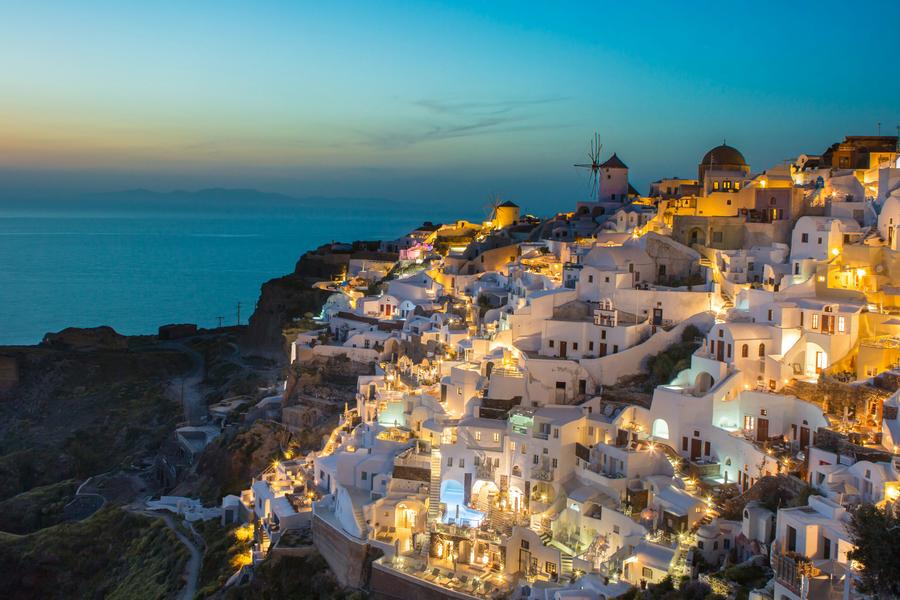
The crescent left by a Bronze Age eruption around 1600 BC, with cliffs dropping 300 metres to a flooded crater and white villages along the rim. Oia's sunset is the famous image and draws several thousand people onto a few narrow lanes every evening - arrive by 6pm for a position, or watch from Imerovigli instead, which is quieter and just as good. The caldera walk from Fira through Imerovigli to Oia is 10 km, three to four hours, and should be done at 7am. Cave hotels here involve hundreds of steps.

UNESCO World Heritage, Archaeological site

Delphi

The sanctuary of Apollo on a terrace of Mount Parnassus, where the Pythia delivered the oracle that Greek states consulted before every major decision, and which the Greeks considered the navel of the world. The Sacred Way climbs past treasuries to the temple, the theatre and the stadium above it, with the whole site looking down a valley of olive groves to the sea. The museum holds the bronze Charioteer, which is one of the finest surviving classical bronzes. Two hours thirty from Athens, and a full day. Go early for the light and the quiet.

Archaeological site

Ancient Akrotiri, Santorini

A Bronze Age Minoan town buried under volcanic ash around 1600 BC and preserved in a way almost nothing else from the period is - two and three-storey buildings with intact staircases, drainage, storage jars and wall frescoes, under a modern roof that makes it comfortable in any weather. Unlike Pompeii there are no bodies, because the population appears to have evacuated in time. It takes an hour and a half and is the best indoor option on Santorini on a hot day or a windy one.

UNESCO World Heritage, Archaeological site

Delos

An uninhabited island thirty minutes by boat from Mykonos that was the mythological birthplace of Apollo and Artemis and the religious and commercial centre of the Aegean - at its peak a city of thirty thousand people, with a sanctuary, a theatre, mosaic-floored houses and the Terrace of the Lions. Nobody has been permitted to live or die on the island since antiquity. Boats run morning and midday and the site closes in the afternoon; there is no shade and no facilities, so take water and a hat. The single best reason to be on Mykonos.

UNESCO World Heritage, Monasteries

Meteora

Six working Orthodox monasteries built on top of sandstone pillars rising up to 400 metres from the Thessalian plain, occupied by hermits from the eleventh century and built up from the fourteenth, originally reached only by rope ladders and nets. Six of the twenty-four survive and are visitable, each closed on a different day of the week, so plan the sequence. Strict dress code with wrap skirts provided for women. Four hours from Athens by road or train to Kalambaka - do it as an overnight, and go at sunset.

Archaeological site, Museum

Knossos and the Heraklion museum, Crete

The largest Bronze Age site on Crete and the seat of the Minoan civilisation from about 1900 BC, with a palace complex of over a thousand interlocking rooms that gave rise to the labyrinth myth. Arthur Evans's early twentieth-century reconstructions in painted concrete are controversial and clients should know what is original and what is not - a guide is essential here. The real frescoes, including the bull-leaping panel, are in the Heraklion Archaeological Museum twenty minutes away, which is the better half of the visit. Go early; there is no shade.

Explore

Off the beaten path

Naxos and the Tragaea villages

The largest Cycladic island and the one that solves the price problem - the same Aegean light and better beaches than Santorini at half the cost, with a proper working economy rather than a tourist one. Inland, the Tragaea valley holds marble villages like Halki and Apeiranthos, Byzantine chapels with tenth-century frescoes, and two unfinished kouros statues abandoned in ancient quarries where they cracked. Mount Zas is the highest point in the Cyclades. Four hours from Piraeus or thirty-five minutes by air.

Milos and the volcanic coastline

A volcanic island in the western Cyclades with a coastline unlike anywhere else in Greece - Sarakiniko's white lunar rock formations, the sea caves and sheer walls at Kleftiko reachable only by boat, and Papafragas's narrow inlet. The Venus de Milo was found here in 1820. It has around seventy beaches, a fishing village of coloured boathouses at Klima, and none of Santorini's crowds. A boat day around the island is the thing to book. Ninety minutes from Santorini by ferry.

Zagori and the Vikos Gorge

The far north-west of the mainland, in Epirus near the Albanian border - forty-six stone villages connected by eighteenth-century arched packhorse bridges, above the Vikos Gorge, which by some measures is the deepest gorge in the world relative to its width. Stone guesthouses, mountain food quite unlike the islands, brown bears and wolves in the Pindus forests, and walking that is genuinely world-class. Six hours from Athens or ninety minutes from Ioannina airport. Almost invisible in Indian itineraries.

Hydra

Ninety minutes from Piraeus by hydrofoil, a Saronic island with no cars, no scooters and no wheeled vehicles of any kind - everything moves by mule, on foot or by boat, and the ban has been in place for decades. Eighteenth-century sea captains' mansions rise in a horseshoe around the harbour, there is a serious artistic history, and the swimming is off rocks rather than sand. It works as a day trip and is far better as two nights. The quietest sophisticated island in Greece.

Explore

Where to stay

Plaka and Monastiraki, Athens

The old quarter below the Acropolis - neoclassical houses, bougainvillaea, the Anafiotika lanes built by Cycladic masons in the nineteenth century, and the flea market and rooftop bars at Monastiraki. Everything a first-time visitor wants is within a twenty-minute walk, including the Acropolis entrance, the Ancient Agora and the Acropolis Museum. Touristy and priced accordingly, but for three nights it is the right answer. Electra Palace and AthensWas are the benchmarks.

Best for: First-time visitors, short stays, walkers, seniors
Stay: 3 nights

Koukaki, Athens

A residential neighbourhood immediately south of the Acropolis Museum, with tree-lined streets, neighbourhood tavernas, good coffee and a metro stop, and the same ten-minute walk to the Acropolis as Plaka at 25-30% less. Quieter in the evening and more like living in Athens than visiting it. The right recommendation for a longer stay, for families, and for anyone who has been to Athens before.

Best for: Longer stays, families, repeat visitors, value-conscious clients
Stay: 3-4 nights

Oia and Imerovigli, Santorini

The caldera-rim villages on the north-west of the island, where the cave hotels with infinity pools and the sunset view are. Oia is the famous one and the most expensive, and its sunset draws thousands of people every evening onto a handful of narrow lanes. Imerovigli, twenty minutes south, has the same caldera view with a fraction of the crowd and noticeably better value. Both involve hundreds of steps and no vehicle access to many hotels - confirm the step count before booking for anyone older.

Best for: Honeymoons, couples, the caldera view, photography
Stay: 3-4 nights

Mykonos Town (Chora) and Ornos

Mykonos Town is a whitewashed maze of lanes with Little Venice's waterfront bars, the windmills and the best walkability on the island - and the loudest nights. Ornos and Platis Gialos, ten minutes south, are sheltered sandy bays with family hotels and calmer water, and are where families and older couples should be. Psarou and Paraga are the beach club addresses and the most expensive. Mykonos taxis are famously scarce, so hotel transfers or a hire car are essential.

Best for: Nightlife and beach clubs (Chora, Psarou), families (Ornos, Platis Gialos)
Stay: 3 nights

Chania old town, Crete

A Venetian harbour ringed by Ottoman and Venetian buildings with a lighthouse at the mole, backed by a lane network of leather workshops, tavernas and small hotels in restored mansions. It is the prettiest town in Greece that is not on a Cycladic island, and it is the base for the Samaria Gorge, Balos and Elafonisi. Crete's west is a completely different holiday from the Cyclades - bigger, greener, cheaper and far less crowded.

Best for: Longer island stays, families, hiking and beaches, food-led clients
Stay: 4-5 nights
Explore

Things to do

Adventure
  • More than the postcard suggests.
  • On the water: sailing the Cyclades on a chartered yacht or a shared catamaran, which is how the islands are best seen and is surprisingly affordable for a group of six or eight; sea kayaking around Milos's volcanic coastline and the Kleftiko caves; diving at Santorini's caldera wall and at Chios; windsurfing and kitesurfing at Paros's Golden Beach and Naxos's Mikri Vigla, which have reliable…
  • On land: the Samaria Gorge on Crete, a 16 km walk down a limestone canyon from 1,250 metres to the Libyan Sea, open roughly May to October and a genuine full day; hiking the Santorini caldera path from Fira to Oia; climbing Mount Olympus over two days with a refuge overnight; rock climbing at Meteora and Kalymnos, the latter being one of the best sport-climbing destinations in the world.
  • The Vikos Gorge and the stone villages of Zagori in the north-west, which is the most overlooked part of Greece.
  • Canyoning on Crete and in the Peloponnese.
  • Cycling on Naxos and in the Peloponnese.
Day trips
  • From Athens: Delphi, 2 hours 30 each way, for the oracle site on Mount Parnassus and one of the best small museums in Greece; Cape Sounion and the Temple of Poseidon at sunset, 1 hour 30; Nafplio, Mycenae and Epidaurus as a full Peloponnese day, 2 hours out; Meteora as a long day by train to Kalambaka, though an overnight is far better; Hydra, Poros and Aegina on a Saronic gulf cruise, with Hydra…
  • Marathon and the Rhamnous site for anyone who wants the battlefield.
  • From Santorini: the caldera boat trip to the Nea Kameni volcano, the Palea Kameni hot springs and Thirassia; Ancient Akrotiri and the Red Beach; a wine tour of the island's Assyrtiko vineyards, which are grown in low baskets against the wind and are unlike anything else.
  • From Mykonos: Delos, a 30-minute boat ride to the uninhabited sacred island that was the religious centre of the Aegean, and the single best reason to be on Mykonos.
  • From Naxos: the marble villages of the Tragaea, the unfinished kouros statues, and Mount Zas.
  • From Chania on Crete: the Samaria Gorge, Balos and Elafonisi beaches, and the Venetian harbour.
After dark
  • Mykonos is the headline and it is a serious international scene - Scorpios, Nammos and the Paradise and Super Paradise beach clubs, with day drinking that runs into the night and prices that shock people who have not been warned.
  • A bottle at a Mykonos beach club is a genuine four-figure euro decision and clients should be told before, not after.
  • Mykonos Town's Little Venice bars at sunset are the gentler version.
  • Athens has a real, unpretentious nightlife that most visitors miss: rooftop bars around Monastiraki with Acropolis views such as A for Athens and Couleur Locale, the Psiri and Gazi districts for bars and live music, and rembetika venues where the traditional urban music is played until 3am.
  • Athens eats late, from 9.30pm, and goes out later.
  • Santorini's evening is sunset drinks and dinner rather than clubs, concentrated in Fira and Oia and expensive in both.
  • Naxos, Paros and Milos have relaxed waterfront bars and nothing more.
  • Crete's Chania and Rethymno have good old-town bar scenes.
  • Outside these, island evenings are a taverna and the sea.
Shopping
  • Olive oil is the genuine buy - Greek extra virgin from Kalamata, Crete or Lakonia is world-class and a fraction of the Indian price, sold properly at the Athens Central Market and at producers on Crete.
  • Alongside it: thyme and pine honey, Kalamata olives, oregano and mountain tea, mastiha from Chios which is a resin used in sweets and liqueur, and Santorini's Assyrtiko wine and Vinsanto.
  • Leather sandals made to measure in Athens - Melissinos in Monastiraki has been doing it since the 1920s - and hand-made ones on Crete.
  • Worry beads (komboloi) and hand-carved olive wood.
  • Ceramics and marble from Naxos and Sifnos.
  • Greek cosmetics with olive oil and donkey milk, which are excellent and cheap.
  • Monastiraki flea market on a Sunday morning for antiques, brass and junk.
  • Avoid the mass-produced "ancient" reproductions sold near the Acropolis, and never buy anything presented as a genuine antiquity - it is illegal to export and prosecutions of tourists do happen.
  • Non-EU residents can reclaim VAT of up to 24% on purchases over EUR 50 from a single store, processed at the airport.
Explore

Festivals & events

  • Usually April or May, and normally a different date from Western Easter
    Orthodox Easter (Pascha)

    The most important date in the Greek calendar, far bigger than Christmas. Good Friday processions with the flower-covered epitaphios, the midnight resurrection service with candles passed hand to hand, fireworks and, on Sunday, whole lambs on spits across the country. It is genuinely moving and worth building a trip around, particularly on an island like Patmos or Corfu. Operationally: it is the busiest domestic travel week of the year, ferries and island hotels sell out, and many businesses close from Good Friday to Easter Monday. Check the Orthodox date each year.

  • June to August
    Athens and Epidaurus Festival

    Ancient Greek drama performed at the Odeon of Herodes Atticus below the Acropolis and at the fourth-century BC theatre at Epidaurus, which has acoustics so exact that a coin dropped in the orchestra is audible in the back row. Even for a client with no Greek, seeing a tragedy in the building it was written for is unlike anything else. Tickets go on sale in spring and the Epidaurus performances sell out; Epidaurus is two hours from Athens, so it needs a car or a coach transfer and a late return.

  • 15 August
    Assumption of the Virgin (Dekapentavgoustos)

    The biggest summer holiday, when Greeks travel to their home islands and villages en masse. Panigyria - village festivals with food, wine and dancing that run until dawn - are held across the islands, and Tinos in particular receives thousands of pilgrims who approach the church on their knees. It is a wonderful thing to witness and an operational nightmare: ferries and island accommodation are booked out weeks ahead at peak prices, and the roads and ports are at capacity. Plan around it or plan for it, but do not stumble into it.

  • February or March, three weeks before Orthodox Lent
    Apokries and Clean Monday

    The Greek carnival season, with the biggest celebrations at Patras, which runs the largest carnival in Greece, and on Skyros and in the northern villages, where older pre-Christian masked traditions survive. It ends with Clean Monday, a public holiday when families fly kites and eat lagana bread and shellfish - and, usefully, a day when the entire national menu is nistisimo, vegan fasting food. Low season, so rates are excellent, but the islands are largely closed.

  • August into September
    Santorini and Cyclades wine harvest

    Santorini's Assyrtiko vines are grown in low woven baskets on the ground to protect them from the wind, a system found almost nowhere else, and the harvest is early because of the heat - usually through August. Several wineries including Santo, Venetsanos and Domaine Sigalas run tastings and harvest events, and the volcanic-soil whites are genuinely distinctive. Book tastings ahead in season. It coincides with the island's most crowded weeks, which is the trade-off.

Explore

Greece in pictures

Greece photo 1
On the ground

Food & drink

Mezedes and the shared table

Not a dish but the format, and the thing to teach clients: order six or seven small plates for the table rather than a main each. Tzatziki, melitzanosalata aubergine dip, fava puree from Santorini, dolmades, saganaki fried cheese, htipiti spicy feta, grilled octopus, keftedes. Most of the vegetarian options in Greek cooking live here, it is how Greeks actually eat, and a table of mezedes with house wine is EUR 18-30 a head.

Ladera and horta

The olive-oil vegetable dishes that come from the Orthodox fasting tradition and are the backbone of vegetarian eating in Greece: gigantes plaki, giant beans baked in tomato; briam, the Greek ratatouille; fasolakia, green beans in oil and tomato; gemista, tomatoes and peppers stuffed with rice and herbs; and horta, the boiled wild mountain greens served warm with lemon and olive oil. Almost all are vegan. Ask for nistisimo food and this is what arrives.

Souvlaki and gyros

The national fast food - skewered grilled meat, or meat shaved from a vertical spit, wrapped in pita with tomato, onion, tzatziki and, in Athens, chips inside the wrap. EUR 4-6 and better than almost anything at four times the price. Vegetarian versions with halloumi or mushroom are now common in Athens. Kostas and Thanasis in Monastiraki are the Athens benchmarks.

Greek salad and feta

The real horiatiki has no lettuce - tomato, cucumber, onion, green pepper, olives and a whole slab of feta on top, with oregano and olive oil poured over, eaten by mopping the bowl with bread. The quality of the tomatoes and the feta is what separates a Greek one from any other. Feta carries a protected designation of origin and must be made in Greece from sheep and goat milk. Vegetarian, ubiquitous and cheap.

Moussaka and pastitsio

The two baked dishes every visitor knows - layered aubergine, potato and spiced minced lamb under bechamel, and the pasta version with the same. Both are meat dishes and both are frequently better at a family taverna than at a tourist restaurant, where they are often reheated. Vegetarian moussaka made with lentils or extra vegetables is increasingly common in Athens and on the larger islands, and is worth asking for.

Loukoumades, yoghurt and honey

Loukoumades are small fried dough balls soaked in honey syrup with cinnamon and walnuts, and they are essentially gulab jamun's Greek cousin, which Indian clients enjoy instantly. Alongside them, thick strained Greek yoghurt with thyme honey and walnuts, baklava, galaktoboureko custard pie, and the mastiha-flavoured sweets from Chios. Greek coffee is served thick and unfiltered in a small cup, with the grounds left at the bottom.

Vegetarian, Jain & dietary

Greece is one of the easier European countries for Indian vegetarians and clients are usually pleased. The reason is religious: the Greek Orthodox calendar includes roughly 180 fasting days a year when meat, fish and dairy are avoided, which has produced a deep everyday repertoire of bean, vegetable and olive-oil dishes that are on every taverna menu. The category to teach clients is "ladera" - vegetables cooked in olive oil - which covers gigantes beans, briam, fasolakia green beans, gemista stuffed tomatoes and peppers, and spinach rice. Add horta, the boiled wild greens with lemon, dolmades, fava puree, tzatziki, Greek salad, spanakopita and a great deal of excellent cheese. The Greek for vegetarian is "chortofagos" and for fasting food "nistisimo", which is reliably vegan and is a genuinely useful word to teach. The hidden ingredients are meat stock in some bean dishes, anchovy in a few sauces, and the fact that Greeks sometimes do not count fish as meat - specify "choris kreas kai choris psari", without meat and without fish. Jain requirements need advance briefing, as onion and garlic are foundational. Athens has a decent number of Indian restaurants around the centre; Santorini and Mykonos have one or two each at high prices; Naxos, Paros, Milos and most of Crete have none, so brief hotels in advance. Halal is available at a handful of Athens restaurants and is not widespread in the islands.

Where & when to eat

Greek food is one of the best-value things about the country and one of the best reasons to come. Street and quick: a gyros or souvlaki wrap is EUR 4-6 and is a proper meal; a spanakopita from a bakery EUR 2-3. Tavernas are the core of it - a full meal of mezedes, a main and half a litre of house wine runs EUR 18-30 a head (about INR 1,980-3,310), and the right way to eat is to order six or seven small dishes for the table rather than a course each. Ouzeri and mezedopoleio do the same with ouzo or tsipouro. Mid-range island restaurants EUR 35-60 a head, rising sharply on Santorini and Mykonos where a caldera-view table is EUR 70-120 a head and is a view charge as much as a food charge - say so. The serious end in Athens is genuinely good and cheap by European standards: Spondi, Hytra and Varoulko run EUR 90-160 for a tasting menu. Athens's Central Market and the Psiri tavernas are where the city actually eats. Timings are late: lunch 2pm-4pm, dinner from 9pm, and a taverna at 7pm will be empty and staffed by people who have not started yet. Sunday lunch is the big family meal.

Food & water safety

Tap water in Athens, Thessaloniki and Crete is safe, treated and good. On the Cyclades it is a different matter: Santorini, Mykonos, Paros and most of the smaller islands rely on desalination and borehole water that is safe for teeth and washing but is brackish, unpleasant to drink, and is not recommended for drinking - clients should use bottled water there, and the hotels will say so. Ice, salads and fresh produce are fine everywhere. Food hygiene is good and gastro risk is low. The real risks are heat and sun: July and August routinely reach 38C, the Acropolis and the archaeological sites have almost no shade, and heat exhaustion is the commonest medical incident on a Greek trip. Carry two litres of water per person on a site day, start early, and take the middle of the day off - this is exactly what Greeks do. Sea urchins on rocky island entries are a frequent minor injury, so wear water shoes. Raw sea urchin and raw shellfish should be approached carefully.

Tipping

Modest and straightforward. Service is generally included, and many tavernas add nothing beyond the bill and a small cover charge for bread. Rounding up or leaving 5-10% in cash is normal and appreciated - on a EUR 45 taverna bill, leaving EUR 50 is right. Do not tip on the card machine, because it frequently does not reach the staff; leave cash on the table. In an upmarket restaurant 10% is appropriate. Taxi drivers: round up to the nearest euro. Hotel porters EUR 1-2 a bag, housekeeping EUR 1-2 a day. Guides are where a tip genuinely matters: EUR 20-40 per couple for a good half day at the Acropolis, EUR 50-80 for a private full day at Delphi or the Peloponnese. Boat crews on a day cruise appreciate EUR 5-10 per person into a shared pot. Do not tip at a bakery or a gyros counter. Note that a bread and cover charge of EUR 1-2 per person appears on most taverna bills and is not a tip.

On the ground

Getting there & around

Flying in

Athens Eleftherios Venizelos (ATH) is the primary gateway and a genuinely good airport. IndiGo began India's first nonstops to Greece in January 2026 - Mumbai-Athens from 23 January and Delhi-Athens from 24 January, three times weekly each on the A321XLR at roughly 7 to 8 hours - and these should be led with while confirming the current days, since a thrice-weekly route is more schedule-sensitive than a daily one. The one-stop alternatives cover every Indian metro: Emirates via Dubai, Qatar Airways via Doha, Etihad via Abu Dhabi and Turkish via Istanbul, all in 11-14 hours total. Thessaloniki (SKG) is the second international gateway and is useful only for northern Greece and Halkidiki. Santorini (JTR) and Mykonos (JMK) handle seasonal direct European flights from about April to October and domestic Aegean, Sky Express and Volotea services year round, but both have small terminals and limited handling capacity, and JTR in particular runs frequent delays in peak season - never build a tight connection through either. Heraklion (HER) and Chania (CHQ) serve Crete. Since the EU Entry/Exit System went live on 10 April 2026, allow extra time for first-entry immigration at Athens.

Airport transfers

Athens airport is 33 km east of the centre. Metro line 3 runs direct to Syntagma and Monastiraki in about 40 minutes for EUR 9 and is clean, easy and the right choice for most clients. The X95 express bus takes 60-90 minutes for EUR 5.50. A regulated flat-fare taxi is EUR 40 by day and EUR 55 at night to central Athens (about INR 4,410-6,060), taking 35-50 minutes - the fare is fixed, so refuse a driver who wants to negotiate. Uber and FREENOW dispatch licensed taxis at similar rates. For a ferry departure, the airport to Piraeus is 50-60 minutes by road or metro line 3 changing to line 1 at Monastiraki, and given that fast ferries leave Piraeus at 7am or 7.30am, an airport arrival the night before with a hotel in Piraeus or central Athens is the only sensible plan. On the islands, hotels arrange port and airport transfers and should be used - Santorini's port road is a hairpin climb and Mykonos taxis are famously scarce.

Ride-hailing

Uber operates in Athens but dispatches licensed yellow taxis rather than private cars, and the local apps FREENOW and Taxiplon do the same - all three are the practical way to get a taxi without a street negotiation. A central Athens hop is EUR 5-10, and the airport is a regulated flat fare of EUR 40 by day and EUR 55 at night. On the islands, ride-hailing effectively does not exist: Santorini and Mykonos have a small fixed number of licensed taxis, they are very hard to get in August, and the answer is a prebooked hotel transfer or a hire car. Naxos, Paros and Crete have taxis in the main towns and little else. Always agree a fare on the islands before setting off, because meters are frequently not used.

Cars & drivers

A private car with an English-speaking driver costs EUR 350-550 a day (about INR 38,600-60,600) and a minivan EUR 500-750. It is the right answer for a Delphi day, a Peloponnese loop taking in Nafplio, Mycenae and Epidaurus, a Meteora trip, and for Crete's mountain roads. In Athens itself it is unnecessary because the metro covers everything. On the small islands a full-day driver is usually poor value against a hire car, except for clients who do not want to drive Santorini's narrow, crowded roads in August, where it is money well spent. The driver is not a guide: a licensed English-speaking guide is a separate EUR 200-350 for a half day, and at the Acropolis, Delphi and Knossos a guide is not optional if the client wants to understand what they are looking at, because on-site interpretation is minimal.

Scooters

This is the safety brief that matters most in Greece. Quad bikes, ATVs and scooters are rented freely on every Cyclades island, often without a proper licence check, and they are the single commonest cause of tourist injury in the islands - gravel roads, loose surfaces, steep descents, inexperienced riders and frequently no helmet. Travel insurance is routinely voided because the client does not hold the correct licence category, leaving them with a bill in lakhs. We do not sell or recommend them, and clients should be told why rather than simply told no. Car hire is the correct alternative and is straightforward with an International Driving Permit alongside the Indian licence, which Greek rental firms and police do check. Island roads are narrow with blind bends and summer traffic; Santorini's are genuinely congested and parking in Oia and Fira is difficult. On the mainland, driving is fine and the motorways are good.

On foot

Athens's historic core is compact and best walked: the pedestrianised Dionysiou Areopagitou runs along the base of the Acropolis linking the museum, the Herodes Atticus theatre and the Ancient Agora, and Plaka and Monastiraki are a twenty-minute spread. The Acropolis itself involves a steep climb on worn, polished marble that is genuinely slippery, plus uneven ground at the top - proper shoes with grip are essential and clients with mobility problems should use the lift, which exists and is free. Expect 7-10 km on an Athens sightseeing day. On Santorini, the caldera walk from Fira to Imerovigli to Oia is 10 km of exposed cliff path taking three to four hours, and it is the best thing on the island - do it at 7am, not at midday. Oia and Fira are stepped villages with hundreds of steps and no vehicle access to many hotels, which matters enormously for older clients and for luggage: confirm the step count with the property before booking. Mykonos Town is flat and walkable.

Finding your way

Google Maps covers Athens transport and mainland roads accurately, and is adequate on the islands. Download Greece offline before island-hopping, because signal on ferries and in the Cretan mountains drops. Ferry timetables are the real navigation problem: they are seasonal, published only a few months ahead, change, and are best handled through Ferryhopper or Ferryscanner, which aggregate the operators - Blue Star, SeaJets, Golden Star and Minoan - and issue tickets. Some sailings still require a paper ticket collected at the port, which catches people out, so check at booking. The OASA and Athens Transport apps handle city buses and the metro. Signage is bilingual in Greek and Latin script in Athens and the airports and much less so in villages; the Greek alphabet is a genuine barrier for road signs, so offline maps matter. English is widely spoken across tourism.

Crossing borders

Greece's land borders are with Albania, North Macedonia, Bulgaria and Turkey. Bulgaria is in Schengen, so that crossing is now internal; Albania and North Macedonia are outside and require a formal crossing, and both admit Indian passport holders with a valid multi-entry Schengen visa in most circumstances, which makes a short Albanian Riviera or Ohrid extension possible for the right client - confirm the current rule before selling it. The Turkish land border at Kipoi is open but is not a routing we use; the useful Turkey connection is by air, Athens to Istanbul in about 1 hour 30 on Aegean or Turkish, which makes a Greece-Turkey pairing straightforward. The other genuinely good option is the short sea crossings from the eastern Aegean islands to the Turkish coast - Rhodes to Marmaris, Kos to Bodrum, Samos to Kusadasi for Ephesus - which take 45-90 minutes, though the Indian client will need a Turkish e-Visa and should be briefed that re-entering Greece uses a Schengen entry. Italy is reached by overnight ferry from Patras to Bari, Ancona or Venice, which takes 15-20 hours and is a specialist product.

On the ground

Money

Currency & exchange

The currency is the euro, at roughly 1 EUR to INR 110.2 - reconfirm at quoting. Indian rupees cannot be exchanged in Greece, so clients carry euros from India or rely on cards. Buy euros in India before departure at a bank or licensed dealer; the rate is better than any Greek exchange bureau, and the bureaux around Syntagma and Monastiraki are among the worst in Europe. ATMs from Alpha Bank, Piraeus Bank, Eurobank and the National Bank of Greece are widely available in Athens, on Crete and in the main island towns, and charge EUR 2-6 per withdrawal from an Indian card plus the Indian bank's fee. Avoid the standalone Euronet ATMs in tourist areas, which push dynamic currency conversion aggressively. Always decline "charge me in INR". Critically, the smaller Cyclades have few ATMs and they run out of cash in August, so draw before leaving Athens or a main island town. A forex card loaded in euros plus one credit card is the practical combination.

Paying

Cards work well in Athens, Crete and the main island towns - contactless is standard, and Greece has pushed card acceptance hard in recent years for tax reasons, so even small tavernas now take them. Visa and Mastercard are accepted broadly, American Express less so. Where cash is still needed: small village tavernas, island bakeries, kiosks, church donations, taxis on the smaller islands, beach sunbed hire, and the occasional family-run guesthouse. Ferry tickets are bought online or at port offices and take cards. Budget EUR 150-250 per person per week in cash and keep small notes, and draw more before heading to the smaller Cyclades where ATMs are few and empty in peak season. There is no visitor-relevant QR system. Note that many tavernas add a EUR 1-2 per person bread and cover charge to the bill, which is normal and not a scam.

On the ground

Culture & etiquette

Customs

Greeks are warm, informal and physically expressive, and the visitor finds it easy. Greet with a handshake, or two cheek kisses among friends. Hospitality - filoxenia - is taken seriously and an offered coffee, ouzo or dessert should be accepted graciously; refusing outright reads as cold. Conversation is loud and interruption is normal rather than rude. Meals are long and the plate-sharing model means ordering for the table, not individually. The everyday pace is later than Indian clients expect: shops reopen after a long afternoon break, dinner starts at 9pm, and being early to a restaurant is odder than being late.

In churches and monasteries, which are working religious buildings, dress modestly with shoulders and knees covered - at Meteora this is strictly enforced and women are given wrap skirts at the door, and trousers on women are not accepted at several of the monasteries. Do not photograph a service or the interior where signs prohibit it. At archaeological sites, do not climb on masonry, do not touch carvings and do not pick up stones - all three are prohibited and the site guards are attentive.

Two sensitivities. The Parthenon Marbles held in the British Museum are a genuine national grievance and the Acropolis Museum is built as an argument for their return, so treat it seriously rather than as a curiosity. And Greek relations with Turkey, the Cyprus question and the naming dispute with North Macedonia are live political subjects on which a visitor should listen rather than opine.

What to wear

Relaxed almost everywhere and strict in exactly two contexts. Churches and monasteries require shoulders and knees covered for everyone; at Meteora and Mount Athos this is enforced at the door, and Meteora hands out wrap skirts to women, including over trousers, which surprises people. A scarf and a light long skirt or wrap in the daybag solves it. Everywhere else, summer dress is entirely casual - Greeks themselves dress well but lightly, and linen, cotton and sandals are the uniform. Beachwear belongs on the beach: walking into a taverna or a town in swimwear is not done and is fined in some municipalities. Upmarket Mykonos and Santorini restaurants and beach clubs have an unwritten smart-resort dress code and will turn people away. Practically: proper shoes with grip for the Acropolis, whose marble is worn smooth and genuinely slippery; a hat, sunglasses and high-factor sunscreen for site days with no shade; a light layer for island evenings and ferry decks, which are windy even in August; and water shoes for rocky island beaches and sea urchins.

Bargaining

Limited and gentler than Indian clients expect. Fixed prices apply in restaurants, hotels, supermarkets, ticket offices, ferries and all organised tours - no negotiation at all. Bargaining is acceptable at the Monastiraki flea market, at island souvenir stalls, with unmetered island taxis and when buying several items from the same craft shop, but the realistic margin is 10-20% and the whole exchange is good-humoured rather than adversarial. Opening at half the asking price reads as insulting here and will end the conversation. Where Indian clients get it wrong is haggling with a small island producer over a bottle of olive oil or a pair of sandals made by hand, which causes offence for the sake of a few euros. Two things genuinely save money and are not negotiations: booking ferries and internal flights early, which halves the cost, and travelling in May, June, September or early October instead of August, which halves the accommodation. Always agree an island taxi fare before setting off.

Useful phrases
Yia sou / Yia sasHello (informal / formal or plural)
KalimeraGood morning
KalisperaGood evening
EfharistoThank you
Efharisto poliThank you very much
ParakaloPlease / you are welcome
NeYes (confusingly, it sounds like no)
OhiNo
SignomiSorry / excuse me
Poso kani?How much does it cost?
Pou ine...?Where is...?
Ton logariasmo, parakaloThe bill, please
Before you go

Entry & documents

Schengen short-stay visa (Type C) · up to 90 days

Passport

Passport must be valid for at least three months beyond the intended departure date from the Schengen area, issued within the previous ten years, with at least two blank pages. The passport submitted with the visa application must be the one carried; a renewal after issue means the visa must be transferred. Names must match the application, the air ticket and the ferry tickets exactly - Greek ferry operators do check names against ID at boarding, which is an extra reason to get the spelling right. Carry printed copies of the visa, hotel bookings, ferry and internal flight tickets, return flights and insurance.

Customs

Standard EU rules. Cash of EUR 10,000 or more must be declared when entering or leaving the EU. Duty-free from outside the EU is 200 cigarettes, 1 litre of spirits or 2 litres of fortified wine, 4 litres of still wine and 16 litres of beer, plus EUR 430 of goods for air arrivals. The trap for Indian travellers is food: meat and dairy products are prohibited from entering the EU entirely, which covers ghee, paneer, home-made snacks containing either and most Indian sweets, and they are confiscated. Plant material and seeds are restricted. The Greece-specific one is antiquities: removing stones, marble fragments, pottery shards or anything of archaeological character from a site or a beach is a criminal offence with genuine prosecutions of tourists, and even attractive old-looking objects bought casually can cause serious problems at the airport - buy only from a licensed dealer with an export certificate. Drones require registration with the Hellenic Civil Aviation Authority and are prohibited over archaeological sites including the Acropolis. Prescription medicines must travel in original packaging with the prescription, and codeine-containing painkillers need a doctor's letter.

Travel insurance

Mandatory. Schengen rules require travel medical insurance with minimum cover of EUR 30,000, valid across all Schengen states for the full duration of the trip, covering emergency treatment and repatriation. The certificate is submitted with the visa application and an inadequate policy is a common reason for a file to be returned. Beyond the requirement, the island context makes it genuinely important: medical facilities on Santorini, Mykonos, Naxos and the smaller Cyclades are basic clinics, and anything serious means an air or sea evacuation to Athens or Crete, which is expensive. Check the policy covers quad bike and scooter use if the client insists on it despite our advice, because most policies exclude it without the correct licence, and check that boat trips, diving and hiking are covered. Cover for trip disruption is worth having because ferry cancellations in the meltemi season cause real cost.

Visa notes

Greece issues a Schengen short-stay Type C visa, and the first thing to get right is the application channel: Greece's external service provider in India is Global Visa Center World (GVCW), not VFS Global. This catches out clients and consultants alike, because every other Schengen country in this market is on VFS. Applications are filed at GVCW centres and through the GVCW portal, with the file going to the Greek consular authority covering the client's jurisdiction. GVCW's footprint in India is smaller than VFS's, so a client in a smaller city may need to travel to a centre.

The consular fee is EUR 90 for adults, about INR 9,900, and EUR 45 for children aged six to twelve, with under-sixes free. On top of that GVCW charges a service fee, and that amount is not published centrally - obtain the current figure from the specific centre handling the file and quote it per centre rather than assuming a national number. The visa permits up to 90 days in any rolling 180-day period across Schengen.

Three conditions matter. First, timing: standard processing is 15 calendar days and can extend to 45 if additional documents are requested. Greece accepts applications up to six months before the intended travel date, which is unusually generous for Schengen, and that window should be used for July and August departures when appointments and processing both slow down. Second, the itinerary: island-hopping plans must be supported by confirmed ferry or internal air segments in the day-wise itinerary, matching the hotel bookings. Greek consular staff check this specifically, and a file showing Athens plus vague island intentions will be returned. Book the ferries and flights before submitting. Third, the standard supporting pack: travel medical insurance with EUR 30,000 minimum Schengen-wide cover, proof of funds, six months of bank statements, income tax returns, an employer or leave letter and confirmed return flights.

One operational change to brief every client on: the EU Entry/Exit System has been fully operational across the Schengen area since 10 April 2026. On first entry the client's fingerprints and facial image are captured, passports are no longer stamped, and the 90/180 allowance is tracked automatically, so allow extra time at Athens immigration.

Schengen fees and procedures change, and the GVCW service fee in particular is not centrally published. Reconfirm on the Global Visa Center World Greece India portal before quoting.

AI ESCAPES CLIENT PRICE: INR 16,579 per adult, all-in, for the Greece Schengen short-stay visa - visa fee INR 9,500 + Ai Escapes service fee INR 5,999 + 18% GST on the service fee INR 1,080. Quote this figure to the client; the government fees above are reference only. (Rate card as of 21 Sep 2026.)

Visa rules change. Our desk confirms the current requirements for your passport before you book.

Before you go

Practical essentials

Power

230V, 50Hz. Sockets are Type C and Type F, the round two-pin European pattern. An Indian three-pin Type D plug will not fit; the common Indian two-pin round plug usually will go into a Type C socket, but carry a universal adapter because hotel sockets vary. Power is reliable in Athens and on the larger islands. On the smaller Cyclades, brief summer outages happen when demand peaks and some cave-style Santorini rooms are short of sockets. Most modern electronics handle 230V without a converter.

Phone & internet

Good and improving. Cosmote, Vodafone Greece and Nova all sell prepaid tourist SIMs for EUR 15-25 (about INR 1,650-2,760) with generous data over 30 days, available at Athens airport and in any phone shop, with passport identification required; eSIM is available from all three. As an EU country, a Greek SIM roams free across the rest of the EU. 4G and 5G are strong in Athens, on Crete and in the main island towns, and adequate on the smaller Cyclades, thinning in the Cretan mountains and on ferry crossings mid-Aegean. Free wifi is widely available in cafes, hotels and on many ferries, and the quality on the islands is variable - a Santorini cave hotel's wifi frequently does not reach the room. Download offline maps and, importantly, download ferry tickets and boarding documents before leaving a signal area.

Opening hours

Greek hours confuse visitors and are worth explaining. Shops traditionally open 9am-2.30pm on Monday, Wednesday and Saturday, and 9am-2pm then 5.30pm-8.30pm on Tuesday, Thursday and Friday, with a long afternoon break - though tourist-area shops in Athens, Santorini and Mykonos now open continuously 10am-10pm in season. Most shops close on Sunday outside tourist zones. Banks 8am-2.30pm on weekdays only. Archaeological sites open 8am and close between 3pm and 8pm depending on season, with summer hours longer - the Acropolis typically 8am-8pm in summer and 8am-5pm in winter, with last entry 30 minutes before, and it has closed during afternoon heatwave hours in recent summers. Museums usually 8am-8pm in summer, with Tuesday as the traditional closing day for several including some state museums - confirm before planning. Restaurants serve lunch 1pm-4pm and dinner from 8pm to midnight or later. The island season runs roughly April to October and much of the Cyclades genuinely shuts outside it.

Apps worth installing
  • Ferryhopper or Ferryscanner (all Greek ferry timetables and tickets - essential)
  • Aegean, Sky Express or Volotea (domestic flights to the islands)
  • Athens Transport or OASA Telematics (metro and buses)
  • Uber, FREENOW or Taxiplon (taxis, which dispatch licensed cabs)
  • Google Maps with Greece downloaded offline
  • Google Translate with Greek downloaded - the alphabet makes road signs hard
  • Acropolis and Hellenic Heritage e-ticket portals (timed entry)
  • Meteo.gr or Poseidon system (weather, sea state and meltemi wind forecasts)
Before you go

Before you pack

Pack
  • Proper shoes with grip - the Acropolis marble is worn smooth and genuinely slippery
  • Wide-brimmed hat, sunglasses and SPF 50 - archaeological sites have no shade
  • Refillable water bottle, and bottled water on the Cyclades where tap water is desalinated
  • Light long-sleeved cotton for site days, more useful than a vest in the sun
  • Scarf and a wrap skirt for churches and Meteora, where dress is enforced
  • Water shoes for rocky island beaches and sea urchins
  • A light windproof layer for ferry decks and island evenings, even in August
  • Universal travel adapter for Type C and F sockets
  • Motion sickness tablets for ferry crossings in the meltemi season
  • Small daypack, and a dry bag for boat days
Documents checklist
  • Passport valid three months beyond departure from Schengen, with two blank pages
  • Schengen visa sticker checked for dates, entries and duration
  • Travel medical insurance certificate with EUR 30,000 Schengen-wide cover, printed
  • Confirmed ferry and internal flight tickets for every island segment - required in the visa file and checked at boarding
  • Day-wise itinerary matching the hotel bookings submitted with the visa application
  • Prebooked Acropolis and Acropolis Museum timed tickets
  • Photocopies of passport and visa kept separately
  • International Driving Permit alongside the Indian licence if hiring a car
  • Confirmation of the number of steps to the hotel room on Santorini, for anyone with mobility issues
  • Prescription medicines in original packaging with the prescription
Before you go

Staying safe

Heat, sun and archaeological sites

Heat exhaustion is the commonest medical problem on a Greek trip by a wide margin. July and August routinely reach 38C and heatwaves touch 40C, and the Acropolis, Delphi, Knossos and Delos have almost no shade - the Acropolis has closed to visitors during peak afternoon hours in recent summers. Start sightseeing at 8am, be off the sites by 11.30am, carry two litres of water per person, wear a hat and use SPF 50. Take the middle of the day off, which is exactly what Greeks do. The Acropolis marble is worn smooth and is genuinely slippery in any weather - proper shoes with grip, and clients with mobility problems should use the lift, which exists and is free.

Ferries, meltemi winds and sea conditions

The meltemi is a strong northerly wind that blows across the Aegean through July and August and it cancels ferry sailings with only a few hours' notice, particularly the high-speed catamarans which are far more weather-sensitive than the big conventional ferries. A cancelled sailing can strand a client on an island overnight, which is why we never schedule a same-day ferry onto an international departure and always build a night in Athens before the flight home. Book the larger conventional vessels for exposed crossings if seasickness is a concern, carry tablets, and check the Poseidon sea-state forecast. Island hydrofoils in rough water are genuinely uncomfortable.

Quad bikes, scooters and island roads

This is the single most important safety brief for the Greek islands. Quad bikes, ATVs and scooters are rented on every island, often without a proper licence check, and they are the leading cause of tourist injury in the Cyclades - gravel, steep descents, inexperienced riders and frequently no helmet. Most travel insurance policies exclude them outright unless the rider holds the correct licence category, leaving a client with a hospital bill in lakhs and an evacuation to Athens. We do not recommend them under any circumstances. Hire a car instead, carry an International Driving Permit, and be aware that island roads are narrow with blind bends and heavy summer traffic.

Wildfires, seismic activity and general safety

Greece is a safe country with low violent crime; the risks are environmental. Summer wildfires on the mainland and larger islands have closed roads, archaeological sites and whole areas in recent years - follow official instructions immediately, and the emergency number is 112, which also issues area alerts by SMS. Santorini sits on an active volcanic system and has experienced periods of elevated seismic activity, which is monitored and communicated; clients should know this rather than be surprised by it. In cities, pickpocketing on the Athens metro line 3 from the airport, at Monastiraki and around Omonia is the practical crime risk - use a zipped crossbody bag. Avoid Omonia and its surrounding blocks after dark.

Before you go

Travel responsibly

Environment

Water is the most pressing issue on the Cyclades, where almost everything is desalinated at high energy cost - take short showers, reuse towels and do not treat an island hotel pool as unlimited. Carry a refillable bottle and use the refill stations that are now common in Athens and on the larger islands, because plastic bottle waste on the small islands has nowhere to go. At archaeological sites, stay on the marked paths, do not touch the carvings and never pick up a stone or a pottery fragment - the Acropolis, Delphi and Knossos all lose material to visitors, and it is also a criminal offence. Do not anchor over or disturb Posidonia seagrass meadows, which are protected. Use reef-safe sunscreen. Travel in May, June, September or October rather than August, which is the single most useful thing a visitor can do for Santorini and Mykonos, both of which are visibly past their carrying capacity in high summer. Choose the ferry over an internal flight where time allows, and use island buses where they run.

Local communities

Santorini and Mykonos receive visitor numbers many times their resident population in summer, largely from cruise ships, and the pressure on water, waste and housing is real - which is why Greece introduced the cruise-passenger levy. Staying overnight rather than day-tripping, and travelling in shoulder season, puts money into the island and takes pressure off it. Spread the itinerary: Naxos, Paros, Milos, Syros and Tinos are as good and are not overwhelmed. Eat at family tavernas rather than the caldera-view chains, buy olive oil, honey and wine from producers, and buy sandals and ceramics from the maker. Do not ride the donkeys up the Fira steps - the welfare problem is well documented, the animals work in extreme heat carrying weights they should not, and every credible local campaign asks visitors to stop; use the cable car or walk. Respect that Oia's streets are residential and that the sunset crowd stands on people's doorsteps. Ask before photographing people, particularly older villagers and in monasteries.

Wildlife

The Mediterranean monk seal is one of the rarest marine mammals in the world and Greece holds most of the remaining population - the Alonissos marine park in the Sporades is the place to see one responsibly, and any operator promising a guaranteed sighting elsewhere should be declined. Loggerhead turtles nest on Zakynthos, Crete and the Peloponnese from May to August: do not use beach umbrellas with spikes on nesting beaches, do not use lights at night near them, and keep well clear of marked nests. Do not touch or stand on Posidonia seagrass or coral. Refuse any captive dolphin show. Do not feed the island cats, which are numerous and semi-feral, or rather do so knowing that the sustainable help is to donate to the local neutering charities that most islands have. Do not buy shells, coral or sea sponges harvested destructively - sponges from Kalymnos harvested traditionally are fine and are a legitimate local industry. On land, Greek mountains hold bears, wolves and wild goats in the north and on Crete; stay on trails in the national parks.

Before you go

Greece FAQs

Do Indian citizens need a visa for Greece, and what does it cost?

Yes. Greece is in the Schengen area, so Indian passport holders need a Schengen short-stay Type C visa. Importantly, Greece's visa application centres in India are run by Global Visa Center World, not VFS Global - going to VFS wastes time. The consular fee is EUR 90 for adults, about INR 9,900, and EUR 45 for children aged six to twelve, plus a GVCW service fee that is quoted per centre rather than published nationally. Processing is 15 calendar days and can run to 45. Greece accepts applications up to six months before travel, which is unusually generous, so file early for a summer trip. Through Ai Escapes, the all-in price is INR 16,579 per adult, covering the visa fee, our service fee and GST.

How many days do I need in Greece?

Seven to nine nights. Three nights in Athens covers the Acropolis, the Acropolis Museum, Plaka and the Ancient Agora with a day out to Delphi or Cape Sounion. Then four nights on one island - Santorini, Naxos or Paros - or three each on two islands if you have eight nights or more, because every island change costs most of a day once ferries and transfers are counted. Crete is a holiday on its own and needs five or six nights. Six nights is the honest minimum. Do not attempt Athens plus Santorini plus Mykonos in a week.

When is the best time to visit Greece?

Late April to mid-June, and September to mid-October. In May and June the islands are 20-27C, the sea is swimmable from late May, the ferries are on full timetables and hotel rates are 40-60% below August. September is arguably the best month of all - the sea is at its warmest, the light is superb and the crowds thin after the first week. July and August are 32-38C with heatwaves reaching 40C, Santorini and Mykonos are at maximum crowding with cruise ships adding thousands of day visitors, prices peak and the meltemi wind cancels ferries. Most Cyclades hotels close from November to March.

Are there direct flights from India to Greece?

Yes, since January 2026. IndiGo launched India's first Greece nonstops - Mumbai to Athens from 23 January and Delhi to Athens from 24 January, three times weekly each on the A321XLR, taking about seven to eight hours. Confirm the operating days when booking, as a thrice-weekly service has less flexibility than a daily one. From other Indian cities, one-stop routings via Dubai on Emirates, Doha on Qatar Airways, Abu Dhabi on Etihad or Istanbul on Turkish take 11 to 14 hours. Santorini and Mykonos have no flights from India - reach them by 45-minute domestic flight or by ferry from Athens.

How much does a Greece trip cost from India?

For eight nights covering Athens plus one island, budget roughly INR 1,25,000 to 2,40,000 per person on twin sharing for land arrangements, plus INR 50,000 to 1,05,000 for return flights - the wide range is because a caldera-view Santorini hotel in August can cost four times the same standard on Naxos in May. Athens is genuinely good value: a taverna meal is EUR 18-30 a head and the metro is EUR 1.20. Budget separately for ferries at EUR 45-130 a crossing, the Acropolis combined ticket at EUR 30, and a provision for Greece's climate-resilience accommodation tax, whose 2026 rates are not yet confirmed.

Is vegetarian food easy to find in Greece?

Yes, and more so than most of Europe. The Orthodox calendar has around 180 fasting days when meat, fish and dairy are avoided, which has produced a whole everyday repertoire of vegetable and bean dishes on every taverna menu - gigantes beans, briam, stuffed tomatoes, green beans in olive oil, wild greens with lemon, fava puree, tzatziki, Greek salad and spanakopita. The word to learn is nistisimo, meaning fasting food, which is reliably vegan. Specify without meat and without fish, because Greeks sometimes do not count fish as meat. Athens has several Indian restaurants; Naxos, Paros, Milos and most of Crete have none, so brief hotels in advance.

Is Greece safe for Indian travellers and families?

Yes. Violent crime is rare and Greeks are welcoming and family-oriented, so children are genuinely enjoyed rather than tolerated in restaurants. The real risks are environmental rather than criminal: extreme summer heat at unshaded archaeological sites, summer wildfires that occasionally close roads and areas, and quad bikes and scooters on the islands, which are the leading cause of tourist injury and which we do not recommend under any circumstances. In Athens, pickpocketing on the metro and around Omonia is the practical concern. The emergency number is 112 and it also sends area alerts by SMS.

How do I get between the Greek islands, and do I need to book ahead?

Yes, book ahead - ferries are a planning exercise rather than a detail. Piraeus to Santorini is 7-8 hours on a conventional ferry or 4.5-5.5 hours on a high-speed catamaran; Santorini to Mykonos is 2-3 hours. Timetables are seasonal and published only a few months ahead, so use Ferryhopper or Ferryscanner and book as soon as dates are fixed. Alternatively, domestic flights on Aegean, Sky Express or Volotea take 45 minutes and often cost less than a high-speed ferry when booked early. Crucially, the meltemi wind cancels sailings at short notice in July and August, so never schedule a ferry to connect with your flight home - always spend the last night in Athens.

Rather talk it through?

Message our travel desk and describe the trip — a real person picks it up, usually within the hour on Indian working days.

Talk to a travel expertSend your dates, we plan the rest